

























Picking The Brain Of An Indie Club Legend
SongCast’s Joe Kleon interviews Chris Zitterbart, who has spent years managing and booking bands in the legendary Cleveland, Ohio clubs Peabody’s and The Agora.
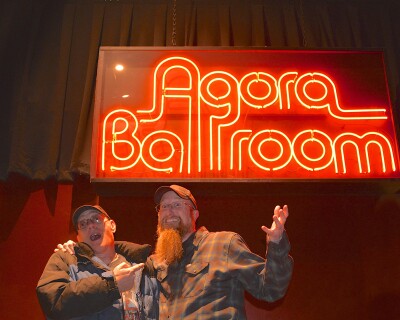
L to R: SongCast’s Joe Kleon & Chris Zitterbart, at The legendary Cleveland Agora.
Today, SongCast’s Joe Kleon picks the brain of Chris Zitterbart. Chris is well known for the decades he spent as the owner of the legendary Peabody’s Concert Club in Cleveland, Ohio, a place that hosted thousands of indie bands since the late 1970’s. Chris is now the talent buyer at another legendary club in Cleveland, The Agora.
If anybody knows about indie bands and what they can do to be successful, it’s Chris. He has received thousands of submissions from bands wanting to play his clubs and booked bands from around the world for many, many years.
Joe: You deal with a lot of indie bands. How many submissions would you say you get, just as a ballpark figure, per month, from bands that are looking to play at the club?
Chris: Well, we get a lot, obviously we get emails, Facebook requests, a lot of phone calls. In a given month, it could be anywhere from 100 to 400 or 500, realistically, depending on whether it’s touring season or not. We’re looking for artists that are gonna bring some people out to the show. Sometimes it gets difficult to decipher when there’s so much volume, but the key is kinda, you know, the music industry is really based upon relationships. If it’s someone I’ve worked with in the past that I trust, I know is gonna bring in a certain amount of heads, that I’m a lot more willing to take a chance with that artist as opposed to somebody who just kind of like hits us up that we might not have any connection or history with.
Joe: What are the do’s and dont’s for indie bands when submitting materials to a club they’ve never played at before and have no experience with?
Chris: We like seeing content online that we can take a look at, you know, get a feel for the sound, where the artist is from, and kind of what the look and the vibe is of the band. We’re trying to see how much activity the band has, how much excitement, how much buzz there is around it. So we’re looking for numbers as well, whether it’s likes or friends or spins or whatever, anything that can help quantify that, show us that the band’s gonna draw some heads out to the show. That’s a very key component.
Joe: What should bands submit when they’re trying to get a gig at a new club?
Chris: Well, the biggest piece is to quickly get to the point, tell us what you’re about. You know, if you send us a massive amount of content, it’s difficult to get through since we have so many submissions on a regular basis. I would say predominantly give us a link to wherever you feel best represents your band, whether it be, you know, Facebook or whatever the content is that you feel best represents you, give us that. We don’t need 1,500 links I think one or two is the best way to go. Something that we can quickly identify what you’re about and what you bring to the table.
Joe: Let’s say two pretty much identical bands submit materials to the club. Which one catches your eye and why?
Chris: I look for bands that are pro and prepared. You’re gonna come into a market you may not have played before. I wanna know that you’re gonna work to bring people out to the event. And there’s two pieces to that. One is, you know, what are you gonna do to promote? And the second piece of it is the networking portion of it. You’re a lot more likely to play if you say, hey, I’m from this town, but I know this band that draws really well in your town. and I’d like to play with that band that draws really well. So me, as a venue owner, I feel more comfortable that there’s gonna be heads in the room that night. So network, talk to people in the market, figure out who’s a good draw, and try to come and play with that band. You’ll be more successful, the show will be more successful, it’s a better win for everyone.
Joe: After your package is sent to the club and you submitted your band for a show, how long should you wait to follow up, and how should you follow up?
Chris: Definitely email or Facebook, whatever that opening line of communication is. As far as follow-up, like a once-a-week kind of a thing, again, we get so many submissions, we try to get back to everybody, but it’s almost impossible. The biggest thing is, you know, if you’re— give us good responses, show us what you can bring to the show. That’ll be the biggest thing to get our attention and hopefully get a response to you as quickly as possible.
Joe: How can bands make sure they have a chance to play your club again, after a first show?
Chris: We do a lot of events, both national touring acts and local regional artists, and the best way really to get in with the venue is to come in with a strong regional act and maybe do a show trade type of a thing. If there’s an artist, whether you’re a rock band, metal band, whatever the genre that you would most appeal to, again, try to network, link up with that band, and then we can try to partner you, bring you in, play with them, play in front of some people, and then hopefully you can return the favor for that band and invite them to play in your town.
Joe: What does it take for new bands in this day and age to make money playing live? I know everyone wants to make money. How do bands do it when they’re just starting out?
Chris: Merch is vitally, vitally, vitally important. I can’t stress that enough for multiple reasons. If a fan is impressed by you, you want that fan to leave with a t-shirt, a sticker, a CD, whatever represents you. The t-shirts are the best because you’re making a little bit of money and those people are gonna promote and advertise you. I mean, you have walking billboards, so that’s a wonderful thing. As far as making money at events, there’s a couple different ways. I mean, we do what we call free ticket giveaway shows where we actually allow the bands to pass out free tickets, which is a great way to get people in the venue. Obviously on a free giveaway show there’s not a lot of money to be paid out, but again, if you’re really set up and have some good merch, you’ll make the money on the merch if people are impressed with you. Once you go to that point where you’re headlining, there’s just a myriad of different ways that we set up events. Anything again from a giveaway show to a door split to, you know, if I feel very comfortable you’re going to draw several hundred people, that’s when you get into the guaranteed money type of a thing. But, you know, every, every situation is a little bit different. But at the end of the day, we’re looking for people that we like to work with, that we like seeing in the venue, and that are going to work to make themselves successful and the show successful.
Joe: What is the best experience he’s ever had working with the band, and what’s the worst experience he’s ever had working with the band?
Chris: Both happened on the exact same night. I had 2 different shows going on. It was a situation where both artists— I was fairly new to this at the time— there were 2 artists coming in headlining, national touring artists. One played our small room, ended up being really nice guys, guys that I’ve invited back over and over and over again. And then in our big room, we had an act that was just a royal pain to work with. Just came in, whole rock star attitude, and they, uh, you know, the attendance was light. We lost a lot of money in the show, and this artist demanded to get paid before going on stage. Um, and we could simply ask for a little bit of flexibility, you know, get some more heads in the door, hopefully sell some drinks, make the cash flow a little bit easier for the night. Long story short, they made life very difficult. The other band who came in and played that night in the smaller room heard about my situation, and we gave them, you know, drink tickets to drink for free. They basically threw the drink tickets in the garbage can and started spending money at the bar so that we would have more cash on hand to pay the— not even their band, a different show. And, you know, it was, it was a really nice gesture. I mean, at the end of the day, that band who spent an extra $20 at the bar, we’ve taken care of them a thousandfold over the years, and they’ve become very good friends The other artist who is just really a terrible pain to work with, you know, I, I really don’t work with anymore. So it’s just, uh, I guess at the end of the day it comes down to if you’re cool to people in the music business, you’re gonna have a lot more chance to come back and play again.
Joe: Talk about bands that have an agent represent them.
Chris: The one nice thing about having an agent is that you already have a connection in place. So for example, if you’re a new band but an agent that I know contacts me, you do have a better chance of coming in and playing the venue simply because with that agent, I kind of know what to expect. As far as an independent artist going out there and directly doing it on your own, I see some bands put together great US tours by themselves. It’s possible to go out there and do that on your own. It takes a lot of work and the nice thing about it is you get to meet those people and you’re booking the shows and you know the venue owners and promoters in each town and there’s a lot of value to that. It is harder to get in the door at the bigger clubs going that route. But, you know, again, there’s a lot of value to get out there and do it yourself and have that experience.
Joe: When you’re talking about these agents and labels that will book shows for bands and set up tours, how does a band go in search of such a label or such an agent and really know that they’re going to do anything for the band? I mean, I know that a lot of these smaller indie labels, there’s a lot of fly-by-night ones, and there’s a lot of them that really just don’t live up to the expectations of a lot of these bands. What can bands look for when they’re searching for someone to represent them, get them gigs, and actually take them to the next level?
Chris: There’s a couple things. First of all, the agent or label or manager wants to know that you, the band, are gonna put in the work, and they wanna know that you, the band, draw, you have good songs, and you have a good product that people want. So I always encourage artists to, you know, keep track. How many shows have you played? How many people do you draw? How many albums have you sold? How many downloads have you sold? How many t-shirts have you sold? This is all quantifiable information Because at the end of the day, that agent or that label is in the music business. They are trying to, you know, support you but make money while they’re at it. And that’s kind of, you know, the business part of the music business. So I do encourage bands to, you know, keep track of their history and what they bring to the table. So that’s what an agent or a manager is going to be looking for. As far as you, the artist, how do you know what is the best fit for you? There’s a couple ways. One is is, you know, what bands do you like? What bands do you respect? Go out and see who they work with. And if you have a chance to work with similar agents or managers who have made those acts successful, then that’s a good way to go. If you are a death metal band, you don’t want a hip-hop promoter. It just doesn’t make sense. So look for artists that you might look up to or enjoy what they do and talk to some of those people. The other big part of it is, you know, the music business is a lot about networking. Talk to people you know and you trust and get their opinion. Say, hey, what do you know about this agent, this label? You know, there’s a lot of us in the business who’ve been doing this for a while, and we want you to be successful. We want you to draw a lot of people out to shows. It’s better for you, it’s better for us, it’s better for everybody. So we’ll be quick to help you if we know that you’re serious and have a good product.
Joe: Give bands an idea of what’s the best way, let’s say they get into your club, whether it be as an opening band or as a headliner for the first time, what’s the best way to promote their shows and what are the things that they should and shouldn’t do, and how far in advance should they start promoting? Just basically the whole idea of what a band should do to promote a show once they get something booked.
Chris: Typically, when I book an event, I want to be booked 6 to 8 weeks in advance to really give myself a good chance to promote the event correctly. As far as an artist jumping on a show, I would recommend 4 weeks out or more. With 4 to 6 weeks, you can do a good job of promoting. Simply putting the event on your Facebook page is not enough. It’s just not. You need to get out and network with people. You need to build a connection and a relationship. As an out-of-town band, that can be tough. My advice is get in town early, find out cool places to go, go talk to people, pass out CD demos, pass out just business cards with a link to wherever your content is. Go make friends, be cool to people, and invite them to come out to your show. There’s a lot of creative ways to get the word out there. One guy that I like is Martin Atkins, and he’s put out a pretty cool book a few years back which has a lot of good promo ideas in it called “TourSmart.” It’s a good book that I really enjoy, and it’s funny, and it’s a lot of ideas in there. But the biggest piece is you got to be in front of people. It’s really tough to go into a new market, just get up and play and expect people to show up. In a town like Cleveland, there’s so many bands playing, there’s so many venues, you want to stand out. Insane Clown Posse is an artist who used to do just that. They used to get into town early, pass out flyers, talk to people. Obviously, that act became huge. It’s putting in the work. It’s getting in front of people, it’s putting a face to a name, it’s making the fans care and want to be there.
Thanks to Chris for taking time to hang with us and share his wealth of experience. To check out the great list of upcoming shows at the Cleveland Agora, hit this link:
https://www.agoracleveland.com/

Comments
No comment